
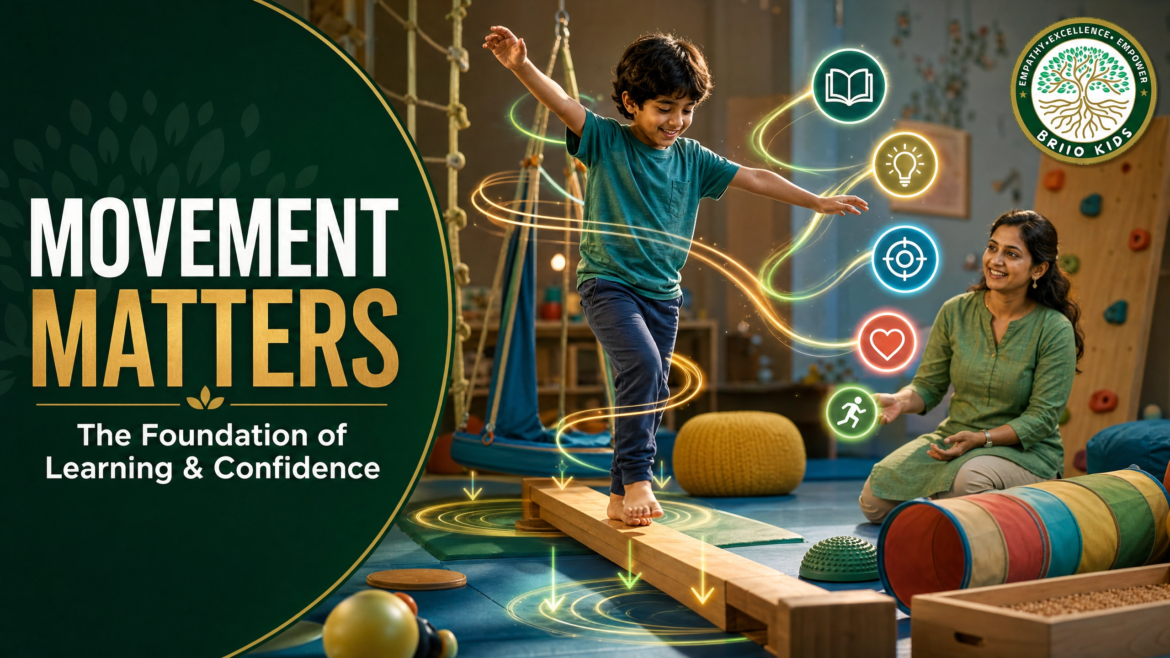
The Hidden Foundation of Academic Success, Emotional Regulation, and Physical Confidence
Q: How does vestibular work (movement, balance) relate to academics? Seems unrelated.
A: The vestibular system is foundational to all learning. Balance, spatial orientation, and coordinated movement activate the neural circuits that underlie attention, executive function, and cognitive processing. A child with vestibular dysregulation experiences auditory processing challenges, attention difficulties, and motor coordination problems—all of which directly impair academics. When you work on vestibular development through movement protocols (swinging, climbing, balance work, spinning), you’re not just building physical skills. You’re literally reorganizing the neural substrate for learning. Many children who “can’t focus” actually have vestibular dysregulation.
Q: My child seems clumsy and avoids physical activity. Should I push movement or respect their preference?
A: Clumsiness and movement avoidance are signs of proprioceptive-vestibular dysfunction, not personality preference. Your child isn’t avoiding movement because they’re lazy or scared—they’re avoiding it because their body doesn’t feel reliable. Without proprioceptive-vestibular development, they’ll remain clumsy, uncoordinated, physically unconfident. But you don’t push traditional exercise. You provide movement through joyful, playful engagement: climbing, swinging, dancing, jumping, wrestling, building confidence progressively. Gradually, their body becomes reliable. Confidence and capability follow naturally.
Q: Is occupational therapy enough for movement development? Why would my child need additional movement work?
A: OT often focuses on fine motor skills and daily living activities. Briio’s movement work is broader: full-body vestibular-proprioceptive integration across all contexts. OT addresses “how to” do things. Briio’s protocols address “how to feel safe and confident doing things.” They’re complementary. OT may teach handwriting mechanics; Briio develops the proprioceptive confidence underlying handwriting. Ideally, both happen together.
Q: How much movement is too much? My child seems to need constant motion.
A: Constant motion-seeking suggests vestibular hyposensitivity—your child’s vestibular system isn’t registering input clearly, so they seek intense input (spinning, jumping, running). This isn’t excessive; it’s their nervous system seeking necessary input. The Briio approach: Provide rich, varied vestibular input throughout the day (swinging, climbing, dancing, spinning) so their system becomes regulated. As vestibular input increases in quantity and quality, the frantic motion-seeking often decreases naturally. Their nervous system reaches homeostasis.
Why Indian Children Often Miss Movement-Based Development
India’s traditional parenting values outdoor play, physical activity, and embodied childhood. Yet for neurodivergent children, movement is often restricted. Parents fear their clumsy child will get injured. So they restrict. They hover. They don’t let them climb, jump, take risks. Teachers worry movement will be “chaotic” or “distract from learning.” So they keep children seated. Therapy focuses on sitting still and focused attention—directly opposing movement needs.
The result: Neurodivergent children in India often experience profound movement restriction—exactly when their nervous systems need movement most. The vestibular-proprioceptive systems remain underdeveloped. And everything that depends on those systems (academics, coordination, confidence, regulation) suffers. The Briio approach reclaims movement as healing. Not reckless. Not chaotic. But joyful, progressive, foundational. Movement is protocol. Physical activity is neurological intervention.
The Movement-Learning Connection
You’ve probably heard someone say: “My child is so smart, but can’t sit still. The teachers say movement is the problem.” Or: “My child is athletic but struggles academically. The school focuses on academics, ignores the movement potential.” Or: “My child sits perfectly still but has no motor skills and no confidence.” These observations reflect a fundamental misunderstanding: Movement is not separate from learning. It’s foundational to it.
The vestibular system (balance, movement, spatial orientation) and proprioceptive system (body awareness, strength, coordination) form the neural foundation for attention, executive function, auditory processing, and emotional regulation. Without vestibular-proprioceptive development, academic learning is extremely difficult. A child may be intellectually capable but physically dysregulated—making it nearly impossible to access that capability. The Briio Movement Protocol doesn’t position exercise as separate from learning. It’s the foundation of learning. Physical development isn’t extra. It’s essential.
Vestibular System: The Foundation of Balance and Attention
Your vestibular system tells your brain where your head is in space, how you’re moving, and whether you’re balanced. It’s not just about physical balance. Vestibular function directly affects: Auditory Processing: The vestibular nerve and auditory nerve are intimately connected. Vestibular dysregulation contributes to auditory processing challenges. A child with poor vestibular function often struggles to distinguish speech in noisy environments, process spoken language clearly, or follow fast-paced conversation.
Attention & Focus: A dysregulated vestibular system creates a sense of instability. The child is constantly micro-adjusting to stay balanced. This internal effort consumes attentional resources. Focusing on anything external becomes extremely difficult. The child looks unfocused or ADHD, but the root is vestibular.
Emotional Regulation: Vestibular dysregulation creates baseline anxiety—a feeling of instability that persists. This anxiety undercuts emotional regulation. A child who feels physically unstable becomes emotionally reactive.
Motor Coordination: Smooth, coordinated movement requires vestibular function. Poor coordination, clumsiness, difficulty with bilateral coordination (using both sides of the body together) all reflect vestibular-proprioceptive dysfunction.
Signs of vestibular dysregulation: Difficulty with balance, avoiding climbing or heights, nausea with movement, difficulty tracking moving objects, poor coordination, attention challenges, auditory processing difficulties, emotional dysregulation, movement avoidance, or conversely, constant motion-seeking.
Proprioceptive System: The Foundation of Confidence and Control
Your proprioceptive system tells your brain where your body is in space and how to control it. This sense is foundational to: Physical Confidence: A child with strong proprioceptive sense trusts their body. They know what their body can do. They take appropriate physical risks. A child with weak proprioception feels disconnected from their body. They’re hesitant, timid, physically unconfident.
Motor Control & Coordination: Proprioception enables precise movement. Handwriting, tying shoes, catching a ball, manipulating small objects—all require proprioceptive awareness. Without it, fine and gross motor skills remain underdeveloped.
Body Boundaries: Proprioception creates a sense of where your body ends and the world begins. A child with weak proprioception has unclear boundaries—bumps into things, stands too close to people, can’t modulate their physical force (squeezes too hard, touches too gently).
Emotional Regulation: Proprioceptive input has a regulating effect on the nervous system. Heavy work, resistance, pressure—these proprioceptive inputs calm the nervous system. A child doing heavy work or resistance play often becomes noticeably more regulated.
Signs of proprioceptive dysfunction: Clumsiness, movement avoidance, low physical confidence, force dysregulation (squeezing too hard or too soft), slumped posture, difficulty with fine motor tasks, seeking heavy work or compression, appearing disconnected from body.
Three Movement Transformation Journeys
Here’s what movement-based development looks like in three Indian families:
Journey 1: Priya’s Academic Breakthrough Through Vestibular Development (Bangalore, Age 9)
Priya struggled academically despite being intellectually capable. She couldn’t focus for more than minutes. Teachers said she was “lazy” or “not trying.” Testing revealed no learning disability—she was just unable to access her capability.
Briio’s assessment revealed vestibular dysregulation. Priya’s balance was poor. She avoided movement. Her auditory processing was challenging. She couldn’t sustain attention. The root cause wasn’t cognitive—it was vestibular.
Instead of academic tutoring, Briio started intensive vestibular work: swinging, climbing, balance activities, spinning, yoga. Joyful, progressive, daily. Nothing academic—just movement.
Within weeks: Priya’s attention improved noticeably. She could focus longer. Her auditory processing seemed sharper. By month three, her academic performance shifted dramatically. Same intelligence. Different access to it.
By age 10, Priya was academically thriving. Not because she studied harder. Because her vestibular system finally functioned well enough to support learning.
Journey 2: Aditya’s Transformation From “Clumsy” to Athlete (Chennai, Age 11)
Aditya was severely clumsy. He fell constantly. Other children mocked him. His parents restricted his activity for safety. He developed learned helplessness—convinced he couldn’t do anything physical. By age 10, he was a spectator to childhood, watching other kids play while he sat out.
Briio identified proprioceptive-vestibular dysfunction. His body wasn’t providing clear feedback. He couldn’t sense his strength or stability. Clumsiness was neurological, not character.
Instead of restricting activity, Briio intensified it. Climbing, heavy work, resistance play, dancing, sports. Progressive, scaffolded, joyful. But consistent. Lots of movement—structured to build proprioceptive-vestibular awareness.
Slowly, Aditya’s coordination improved. He fell less. He was able to participate in sports without embarrassment. By age 12, he was playing cricket with peers. Not elite athlete—but genuinely participating, genuinely capable.
His father reflected: “He was never broken. He just needed movement input to develop the sense that his body was reliable. Once he felt that, everything changed.”
Journey 3: Ravi’s Behavioral Transformation Through Movement Regulation (Pune, Age 8)
Ravi was behaviorally dysregulated—constant movement-seeking, difficulty sitting, impulsive actions, emotional volatility. His school recommended ADHD medication and behavioral interventions.
Briio identified vestibular hyposensitivity. Ravi’s vestibular system wasn’t registering input clearly. His constant seeking was his nervous system’s attempt to get sufficient input. He wasn’t ADHD; he was under-stimulated proprioceptively.
Instead of restricting movement, Briio provided intensive proprioceptive-vestibular input: heavy work, resistance, swinging, jumping, pushing/pulling activities. Not punishment or exercise. Just rich, varied sensory input.
As input increased, paradoxically, Ravi’s dysregulation decreased. His nervous system no longer desperately sought motion. He could sit when needed. His emotional regulation improved. His behavior normalized—not through discipline but through adequate sensory input.
By age 9, Ravi was thriving. His school noted improved focus and emotional regulation. His parents had stopped considering medication. The “ADHD” dissolved when his vestibular-proprioceptive system got what it needed.
Vestibular-Proprioceptive Protocols: What Actually Works
Briio’s Movement Protocols activate vestibular and proprioceptive systems through specific activities: Vestibular-Activating Activities: Swinging (all types), spinning, rocking, tilting, rolling, climbing, balance activities, yoga, dancing, trampoline work, slides. These directly stimulate the vestibular system.
Proprioceptive-Activating Activities: Heavy work (carrying, pushing, pulling), resistance activities (wrestling, tug-of-war), jumping, squeezing, climbing, lifting, building. These provide joint and muscle input that the proprioceptive system craves.
Combined Movement: Activities that engage both systems simultaneously: dancing to music (vestibular + auditory), climbing while carrying something heavy (vestibular + proprioceptive), sports (complex coordination), martial arts (control + movement).
Key principles: Joyful, not forced. Progressive, not overwhelming. Consistent, not sporadic. Varied, not repetitive. And critically: Process-focused, not outcome-focused. Your child doesn’t need to be good at movement. They need to engage in it authentically.
Building Movement Into Daily Life
You don’t need special equipment or classes. Movement can be woven into everyday life:
- Before Academic Work: 15 minutes of vestibular-proprioceptive input (heavy work, movement, swinging) before academic tasks dramatically improves focus and learning capacity. Schedule it intentionally.
- During Transition Times: Movement breaks between activities. Not as punishment (“Go run around because you’re hyperactive”) but as support (“Let’s do some swinging to help your body transition”).
- Incorporate Heavy Work: Ask your child to carry groceries, move furniture, help with physical household tasks. Natural proprioceptive input woven into daily life.
- Create Home-Based Movement Spaces: A corner for swinging, climbing, or jumping. Don’t require formal setup—a hanging rope, cushions for climbing, space for dancing. Accessible, inviting, consistent.
- Make It Family Activity: Instead of positioning movement as your child’s therapy, make it family practice. Dance together. Play together. Be active together. Normalizes movement as joy, not intervention.
- Build Progressively: Start with activities your child already enjoys. Add gradually. Don’t force challenging movement. Let capacity build naturally.
If you want structured guidance for movement-based development, Briio’s Sensory & Motor Protocol and parent coaching are specifically designed to integrate vestibular-proprioceptive work into your daily family life.
Why Movement Matters for Everything (Academic, Social, Emotional)
Vestibular-proprioceptive development doesn’t just improve coordination. It transforms everything:
Academic Performance: Improved attention, auditory processing, executive function, and the confidence to attempt challenging cognitive work.
Social Confidence: Physical confidence creates social confidence. A child who feels their body is reliable becomes more willing to take social risks.
Emotional Regulation: Proprioceptive input has an inherent calming effect. Heavy work, climbing, resistance—these activities organize the nervous system.
Self-Esteem: A child who discovers their body is capable, strong, reliable develops genuine self-esteem—not from praise, but from experiencing mastery.
Independence: Physical confidence enables independence. A child who trusts their body can manage physical tasks independently.
Movement as Foundation, Not Luxury
You’ve probably been told: Focus on academics first. Movement is extra. Therapy sessions are more important than playtime. Sitting still shows readiness to learn. This is backwards. Vestibular-proprioceptive development is foundational. A dysregulated vestibular-proprioceptive system undermines everything else. Academic progress, social connection, emotional regulation, behavioral improvement—all flow from movement-based sensory development.
The Briio Movement Protocol doesn’t position physical activity as supplementary. It’s primary. Not instead of other interventions, but foundational to them. When your child’s vestibular and proprioceptive systems are developed, everything that depends on those systems improves naturally.
Ready to prioritize movement-based development in your child’s journey? Explore Briio’s Sensory & Motor Protocol, movement-rich activity bundles, or parent coaching designed to integrate vestibular-proprioceptive work into daily family life. Discover how movement becomes the foundation of academic success, social confidence, and lifelong capability.
The Briio Way: Movement as Foundation. Vestibular-Proprioceptive Development as Primary. Capability Built Through the Body.