
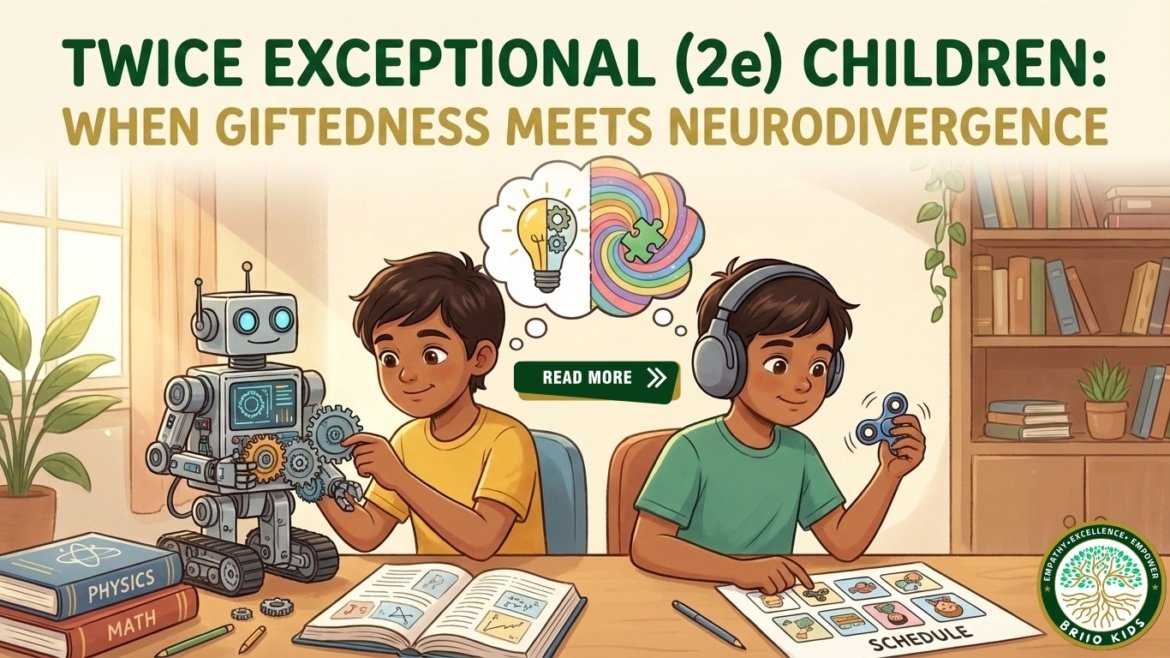
Some children surprise parents and teachers with extraordinary talents in one area alongside unexpected struggles in another. A child might solve complex puzzles quickly yet freeze during simple writing tasks, or they may speak like a miniature professor but find social situations overwhelming. These are traits often seen in twice exceptional or 2e children.
Twice exceptional children have both high intellectual abilities and a neurodivergent condition such as autism, ADHD, dyslexia, dyspraxia, or sensory processing differences. Their giftedness and their challenges are intertwined, creating a unique developmental profile. In India, awareness of 2e learners is still emerging, which means many children go unrecognised or misunderstood.
This blog explains who 2e children are, why they are often missed, what their educational and emotional needs look like, and how parents can nurture both their strengths and their challenges.
1. Defining Twice Exceptional (2e)
A twice exceptional child shows giftedness in one or more domains along with a learning difference or neurodevelopmental condition.
Components of 2e
Giftedness
Gifted traits often include
- high IQ or advanced cognitive abilities
- rapid learning ability
- deep curiosity
- intense focus on interests
- advanced vocabulary
- strong problem solving skills
Neurodivergence
Common co-occurring differences include
- autism
- ADHD
- dyslexia
- dysgraphia
- dyscalculia
- sensory processing differences
- anxiety disorders
These children are exceptional because they simultaneously demonstrate remarkable strengths and genuine developmental challenges. Their abilities do not cancel out their difficulties, and their difficulties do not diminish their abilities.
2. Why Twice Exceptional Children Are Often Missed
Parents and schools in India frequently overlook twice exceptional profiles for two main reasons: strengths mask challenges or challenges mask strengths.
When strengths mask challenges
A child may
- use strong vocabulary to hide comprehension gaps
- rely on memory to compensate for weak writing or planning skills
- appear calm in class but struggle internally with sensory overload
- perform well in oral tests but poorly in written exams
Teachers may assume the child is doing fine academically and socially, delaying intervention.
When challenges mask strengths
A child may
- show poor handwriting that overshadows advanced reasoning skills
- be labelled lazy or inattentive due to ADHD
- have rigid behaviour that hides high problem solving skills often seen in gifted autism
- avoid schoolwork out of frustration, appearing unmotivated
As a result, teachers focus on deficits and miss the child’s potential.
Systemic reasons for missed identification
- limited training for teachers in neurodiversity
- focus on grades rather than learning profiles
- lack of screening tools for giftedness combined with special needs
- social stigma attached to both autism and giftedness
- pressure to fit into standardised school systems
Early recognition helps children receive the right balance of challenge and support.
3. Unique Struggles of 2e Children
Twice exceptional children often develop asynchronously. Their emotional, cognitive, and social skills may grow at different rates, creating internal conflict.
Perfectionism
Many 2e kids have high expectations for themselves. When their performance does not match their intellectual understanding, they may
- avoid tasks they fear failing
- become anxious or frustrated
- refuse to try new activities
- melt down when work is imperfect
Their emotional sensitivity amplifies these reactions.
Asynchronous development
A child may
- reason like an older child
- behave emotionally like a younger child
- have advanced vocabulary but limited social communication
- excel in maths but struggle with handwriting
This uneven development leads to misunderstandings both at home and in school.
Sensory and behavioural challenges
2e children with autism or ADHD may
- experience sensory overload
- struggle with transitions
- show rigidity
- appear impulsive
- find group work overwhelming
These challenges often overshadow their abilities if not understood correctly.
Social challenges
Many 2e children
- prefer intellectual conversations over peer play
- feel misunderstood by classmates
- experience loneliness
- struggle to read social cues
- mask their discomfort to fit in
Their advanced thinking combined with emotional vulnerability increases the risk of anxiety.
4. Educational Needs: Beyond Regular and Special Education
Twice exceptional children do not fit into traditional education models. They require environments that challenge their intellect while supporting their neurodivergent needs.
What 2e kids need academically
- differentiated instruction
- opportunities to explore advanced interests
- project based learning
- flexible pacing
- enrichment programs
- alternative assessments like oral testing or visual projects
Standard memorisation based curriculum does not suit their learning profile.
What 2e kids need support wise
- occupational therapy for motor or sensory differences
- speech therapy for social communication
- executive functioning coaching
- behaviour and emotional regulation support
- resource teachers who understand giftedness and neurodiversity
The combination of support and challenge is the formula for success.
The biggest mistake schools make
Offering only special education support or only gifted programs.
2e learners need both.
5. Social and Emotional Challenges
Strong intellectual ability does not guarantee social maturity. Many 2e children face unique emotional hurdles.
Emotional intensity
2e children often
- feel emotions deeply
- react strongly to small setbacks
- internalise criticism
- have advanced self awareness that leads to anxiety
Their minds analyse everything, which can lead to overthinking.
Social difficulties
- difficulty making friends
- struggles with group dynamics
- preference for older children or adults
- feeling out of place in classrooms
- misreading tone or facial expressions
Children with gifted autism may struggle even more with social reciprocity.
Behavioural misunderstandings
Adults may view their behaviour as
- stubbornness
- disrespect
- laziness
- lack of interest
when the root cause is sensory overload, perfectionism, or frustration from unmet needs.
Mental health risks
Research shows higher rates of
- anxiety
- depression
- low self esteem
in 2e adolescents when their abilities are not recognised or supported.
Emotional support is as important as academic support.
6. Finding Appropriate Schools in India
India’s education system is primarily standardised, which makes it challenging for twice exceptional students. However, parents can still find supportive environments with careful evaluation.
What to look for in a school
Flexible teaching practices
Differentiated learning, project work, and openness to alternative assessments.
Willingness to collaborate
Schools that work with therapists, include parents in planning, and modify expectations when necessary.
Acceptance of neurodiversity
Schools that actively support autism and ADHD instead of viewing them as problems.
Enrichment opportunities
STEM labs, arts programs, coding clubs, Olympiad training, robotics, or creative writing.
Reasonable class size
Smaller classrooms improve attention and emotional support.
Clear policies
Schools that allow AAC devices, sensory breaks, noise cancelling headphones, or modified tasks.
Types of schools to explore
- mainstream schools with learning support departments
- inclusive schools with trained staff
- alternative schools with flexible curriculums
- international schools with differentiated instruction models
Parents may need to advocate strongly, but awareness is improving across major Indian cities.
7. Nurturing Both Giftedness and Supporting Challenges
2e parenting requires a balanced approach. Encouraging strengths without ignoring struggles is the key to helping a twice exceptional child thrive.
Strategies to nurture giftedness
- Provide opportunities for passion projects
- Enroll in advanced classes that match interests
- Encourage creative expression
- Offer books, puzzles, scientific kits, art supplies
- Expose the child to mentors in areas of talent
Giftedness needs stimulation and challenge.
Strategies to support challenges
- Use occupational therapy for sensory and motor needs
- Provide speech therapy for social communication
- Build executive functioning skills through checklists and visual schedules
- Teach emotional regulation tools
- Break large tasks into manageable steps
- Use positive reinforcement instead of punishment
Support and challenge must coexist.
Importance of advocacy
Parents who understand 2e profiles can explain their child’s needs to teachers, therapists, and extended family. Educating others reduces stigma and improves cooperation.
8. Famous Twice Exceptional Individuals
Twice exceptional profiles are not new. Throughout history, many great thinkers showed traits aligned with gifted autism or other neurodivergent profiles.
Albert Einstein
Known for delayed speech in childhood along with exceptional mathematical and conceptual reasoning. He is often referenced as a possible example of gifted autism.
Temple Grandin
A world renowned scientist and autism advocate. Her visual thinking abilities and unique sensory insights revolutionised livestock handling systems worldwide.
Nikola Tesla
Another individual speculated to have had twice exceptional traits due to his intense focus, exceptional memory, and sensory sensitivities.
Leonardo da Vinci
Often considered twice exceptional for his extraordinary creativity alongside unusual learning patterns.
Modern 2e achievers
Many programmers, engineers, musicians, and artists credit their neurodivergent traits for their success.
These examples show that neurodivergence is not a limitation when combined with the right support.
Conclusion
Twice exceptional children are some of the most remarkable learners. Their giftedness and their challenges coexist in a way that requires recognition, patience, and understanding. When strengths overshadow difficulties, the child is misunderstood. When difficulties overshadow strengths, the child is underestimated. The 2e profile becomes clear only when both sides are seen together.
Parents, educators, and therapists must work as a team to provide an environment that stretches the child’s abilities while supporting emotional, sensory, and learning needs. With the right balance, twice exceptional children become confident, innovative thinkers who use their unique brains to contribute meaningfully to the world. Gifted autism, ADHD, dyslexia, and other neurodivergent conditions do not diminish a child’s intelligence. They shape the way the child learns, feels, and interacts. When families learn to nurture both giftedness and challenge, the child can thrive academically, emotionally, and socially.