
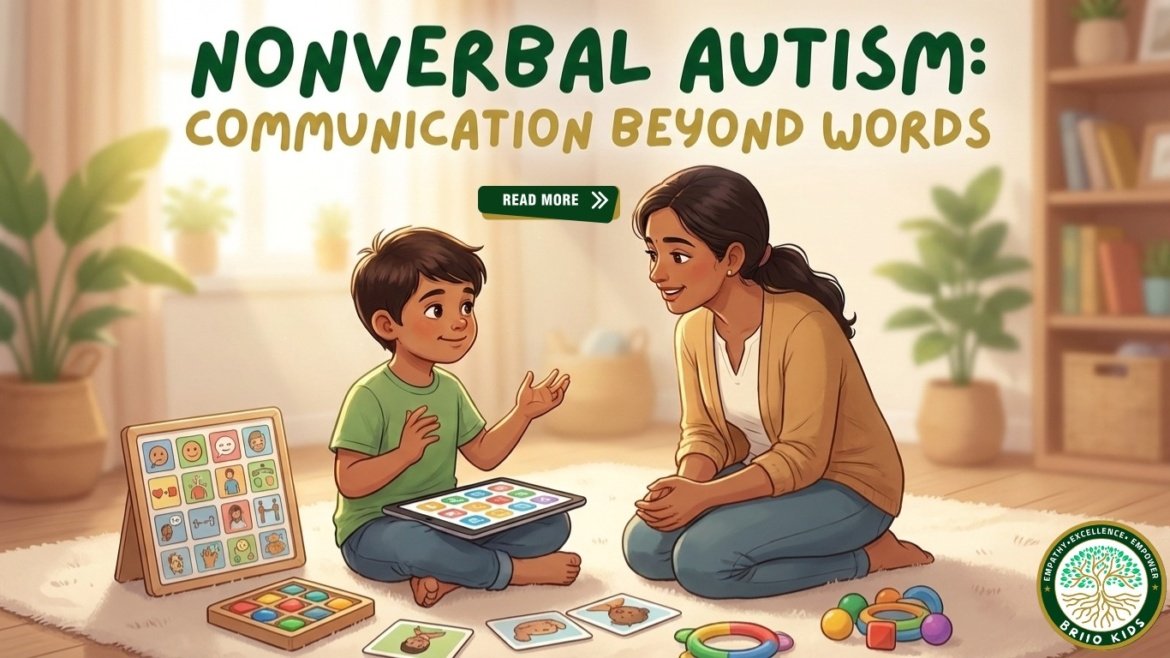
When parents hear the term “nonverbal autism,” they often imagine a lifetime without communication. This fear is common but based on outdated assumptions. Today, specialists understand that speech is only one form of communication, and many autistic children who do not speak can still learn to express themselves clearly, meaningfully, and independently through other communication systems.
This blog explains what nonverbal autism truly means, clears common misconceptions, explores evidence-based communication methods, and provides practical guidance for families across India who want to help their child communicate beyond spoken language.
1. What Nonverbal Autism Really Means
Nonverbal autism does not mean a child cannot understand, think, or communicate. It simply means the child does not use spoken words as their primary communication method. Professionals today use more accurate terms because communication exists on a wide spectrum.
Terms used by experts
Nonverbal
The child does not use spoken words functionally.
Nonspeaking
A broader and more respectful term that recognizes that the child communicates in other ways.
Minimally speaking
The child uses a few words or phrases but not consistently for communication.
Unreliable speech
The child may speak sometimes but cannot use speech to express all needs.
These distinctions ensure parents and professionals focus on communication strengths, not limitations.
2. Presuming Competence: Intelligence Is Not Equal to Speech
A common myth in India is that if a child does not speak, the child is not intelligent. This misconception has harmed many children by lowering expectations and creating emotional barriers.
Presuming competence means
- assuming the child understands more than they can express
- offering age-appropriate learning opportunities
- respecting their communication attempts
- avoiding baby talk or reduced expectations
Many nonspeaking autistic individuals communicate complex thoughts through typing, AAC devices, or letterboards once given the right support.
Speech is not a measure of intelligence. It is simply one communication channel.
3. Alternative Communication Methods
Communication is a human right. When speech does not develop as expected, alternative and augmentative communication methods help the child express needs, emotions, choices, and thoughts.
Below are the most established and widely used autism communication methods.
A. Picture Exchange Communication System (PECS)
PECS is one of the most popular structured systems for nonspeaking children.
How PECS works
- The child hands over a picture to request something
- Pictures represent objects, food, activities, or actions
- Gradually, children learn to form simple sentences through picture combinations
Benefits of PECS
- Teaches functional requesting early
- Reduces frustration and behaviour challenges
- Helps children understand cause and effect
- Easy for schools and families to implement
- Effective for children with limited motor speech skills
PECS can be introduced at home or school and requires consistent practice.
B. Sign Language
Sign language is a rich and expressive communication method for children with strong visual learning abilities.
Benefits
- Enhances communication without technology
- Helps the child express basic needs
- Supports joint attention and imitation skills
- Can be taught in daily routines
However, some children may have motor planning difficulties or limited imitation abilities, making sign language challenging. In such cases, other AAC methods may work better.
C. AAC Devices and Apps
Augmentative and Alternative Communication devices include both basic boards and high-tech speech-generating systems.
Types of AAC
1. Low tech
- Communication boards
- Picture books
- Letterboards
- Topic boards
2. High tech
- Tablets with AAC apps
- Speech-generating devices
- Touch screen communication systems
Common AAC apps used in India
- Avaz
- Proloquo2Go
- TD Snap
- Jellow AAC
- LetMeTalk
- ActionCards
AAC devices allow children to
- express full sentences
- build vocabulary
- develop literacy skills
- participate in classroom activities
- gain autonomy
Research shows that AAC does not prevent speech development. In fact, AAC often increases spoken attempts because the child feels understood.
D. Facilitated Communication: Understanding the Controversies
Facilitated communication involves a helper supporting the child’s arm or hand while typing. International research highlights strong concerns with this method.
Concerns
- The facilitator may unintentionally influence the child’s typing
- Messages may not be truly from the child
- It can give a false sense of progress
- It raises ethical risks
Because of these concerns, major professional bodies worldwide do not recommend facilitated communication. However, independent typing methods such as RPM and S2C are used in some communities, though evidence remains debated. Parents should ensure transparency, ethical practice, and trained professionals.
4. Developing Receptive Language
Receptive language refers to how a child understands spoken words, instructions, gestures, and nonverbal cues. Many nonspeaking autistic children have stronger receptive language than expected.
Parents can support receptive language through
- consistent visual supports
- simple instructions paired with gestures
- daily routines with predictable language
- modelling AAC use
- labelling objects and actions
Receptive language builds the foundation for expressive communication, whether through AAC, gestures, or spoken words.
5. Supporting Communication at Home and School
Successful communication requires consistency across environments.
Home strategies
Use visual schedules
Helps children understand routines and transitions.
Offer choices
Use pictures or AAC to offer yes or no or food, toy, and activity options.
Model communication
Parents should use AAC devices themselves to show how communication works.
Reduce verbal overload
Use short, clear phrases.
Celebrate all communication attempts
Pointing, gesturing, pulling a parent’s hand, or selecting a picture are all meaningful steps.
Create communication opportunities
Pause before giving an item to encourage requesting through AAC or gesture.
School strategies
Allow AAC devices in classrooms
Teachers must treat AAC as the child’s voice.
Train staff
Teachers and support staff need basic AAC training to help the child communicate consistently.
Use peer modeling.
Non-autistic peers can naturally model communication behaviors.
Incorporate AAC in academics
Label classroom areas, reading time, and daily activities with AAC boards.
Provide sensory supports
Regulation improves communication ability.
Teachers and parents must collaborate to build a communication-rich environment.
6. Technology Resources Available in India
India has seen rapid growth in AAC availability over the last decade. Families now have access to devices, apps, and local support systems.
Popular AAC tools in India
Avaz AAC
Indian-developed, with multiple language options and culturally relevant symbols.
Jellow AAC
Created by IIT Bombay, designed for Indian users with simple symbol sets.
Proloquo2Go
A globally popular AAC app with highly customizable features.
TD Snap
Used internationally, it supports multiple symbol systems.
LetMeTalk
A free AAC app, useful for beginners or families exploring AAC for the first time.
Device options
- Tablets with protective cases
- Dedicated speech-generating devices
- Touchscreen communication boards
Service providers
- Speech and language therapy centres
- Early intervention schools
- Nonprofit organisations supporting AAC adoption
- Teletherapy providers for remote families
AAC adoption in India is growing, but awareness still needs improvement. Schools and therapists benefit from training programs to use AAC more effectively.
7. Success Stories of Nonspeaking Autistic Individuals
Real-life stories offer hope and perspective to families beginning their AAC journey.
Example 1: From Picture Exchange to Speech
A five-year-old boy in Bengaluru began PECS to request food and toys. Within a year, he moved from exchanging pictures to forming two-word combinations. Over time, he began to use spoken words that mirrored his PECS vocabulary. AAC helped him bridge the gap to speech.
Example 2: A Girl Who Communicates Through an AAC Device
A seven-year-old girl in Chennai spoke only a few sounds. Once introduced to an AAC app, she began expressing full sentences like “I want to go out” and “I am tired.” Her confidence grew, and she now participates actively in school activities.
Example 3: The Teenager Who Typed His Thoughts
A nonverbal fifteen-year-old in Delhi learned to type independently after years of using a letterboard. His teachers discovered his strong vocabulary and intelligence once he gained access to written communication. Today he uses a tablet-based AAC system for academics.
Example 4: A Young Child Connecting Through Sign Language
A four-year-old in Mumbai used basic signs like “eat,” “drink,” “more,” and “stop” to reduce frustration during play and meals. Over time, he became more regulated and began combining signs with vocal attempts.
These stories show that communication emerges in diverse ways and should never be measured by speech alone.
Conclusion
Nonverbal autism does not mean the absence of communication. Children who do not speak can learn to communicate through pictures, gestures, AAC devices, sign language, or typing. What matters most is early support, presuming competence, consistent modelling, and building a communication system that fits the child’s strengths.
Families in India now have greater access to AAC devices, apps, trained professionals, and specialized schools than ever before. With the right tools and understanding, children can express their needs, share their thoughts, and build meaningful connections with the people around them. Every child deserves a voice. AAC and alternative communication methods ensure that every child, regardless of speech ability, has the opportunity to communicate with confidence and dignity.